
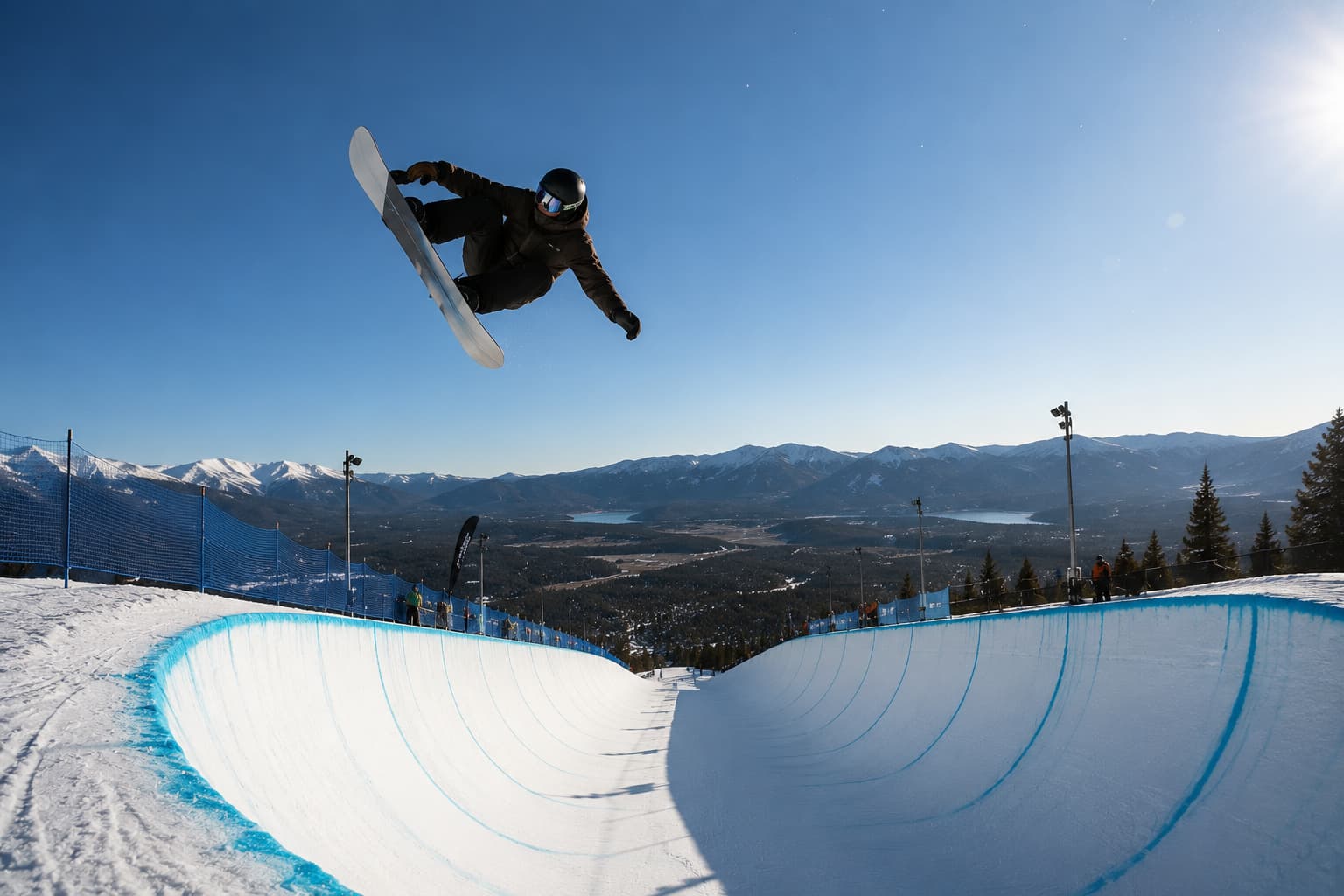
Watch a skilled rider in a halfpipe and it looks like pure athleticism, an explosion of power launching them high above the lip again and again. But the truth is stranger and more elegant than that. The best halfpipe riders are not the strongest; they are the ones who best understand, in their bodies if not in words, the physics of the curve beneath them. A halfpipe is a machine for converting motion into height, and the rider who masters its geometry can fly higher, with less effort, than one who simply tries to muscle their way up the wall. Understanding this hidden physics is what separates a rider who exhausts themselves after three hits from one who could ride for an hour.
Start with the shape itself, because the shape is the whole secret. A halfpipe is essentially two concave ramps facing each other across a flat bottom, each wall curving smoothly from horizontal ground up toward vertical at the top. That curve, called the transition, is not arbitrary. It is a carefully designed arc that lets a rider trade speed for height and height for speed, over and over, the way a pendulum trades motion for position. When a rider drops in from the top, they convert the potential energy of their raised position into pure speed as they rush down the wall. That same speed then carries them up the opposite wall, where it converts back into height. The halfpipe is, at heart, an energy exchange machine, and a good rider is simply someone who has learned to work with that exchange rather than against it.
The single most important skill in the halfpipe, and the one that reveals the physics most clearly, is pumping. This is the technique that lets a rider gain speed without ever pushing off the ground or taking their feet off the board. It looks like magic: the rider seems to accelerate out of nowhere. The mechanism is the same one every child discovers on a playground swing. To go higher on a swing, you do not need someone to push you; you pump your legs, crouching and rising at precisely the right moments, and the swing climbs higher with each cycle. The halfpipe rider does exactly this. As they travel through the curved transition at the bottom of the wall, where the forces are greatest, they push down hard, straightening their legs and driving their weight into the ramp. Timed correctly, this adds energy to the system on every pass, and the rider climbs higher and higher with no external push at all.
The crucial insight is that timing, not strength, is what makes pumping work. Pushing down at the wrong moment does nothing, or worse, kills your speed. Pushing down at the bottom of the transition, at the exact point where the curve is redirecting your momentum from downward to upward, is what channels your effort into height. This is why a light, well-timed rider outperforms a powerful but poorly timed one. The energy is not coming primarily from the rider’s muscles; it is coming from gravity, and the rider’s job is simply to add small, perfectly timed inputs that the geometry of the pipe then amplifies. Fighting the pipe wastes energy. Flowing with its rhythm multiplies it.
The arc matters just as much when it comes to getting airborne. A rider does not launch off the halfpipe by jumping. They launch because the transition curve redirects their travel. As they race up the wall, the curve steadily turns their horizontal-ish motion toward vertical, so that by the time they reach the lip they are already traveling almost straight up. The speed they built through pumping and dropping in becomes altitude, carrying them above the coping into the air. A rider going faster reaches the lip with more speed still to spend, and so flies higher. The height of the trick, what riders call amplitude, is therefore mostly a product of accumulated speed and a clean line through the transition, not of an explosive leap. The perfect arc does the launching; the rider just has to ride it correctly.
This is also why a smooth, precise line through the pipe is so prized, and why a sloppy one is so costly. Every unnecessary movement, every edge caught, every moment the rider is off the ideal path bleeds speed out of the system. Because the whole enterprise runs on conserving and building momentum, small inefficiencies compound quickly. A rider who wanders across the flat bottom or approaches the wall at a bad angle arrives at the lip with less speed and less height, and has to work far harder to recover it. The elegant riders, the ones who seem to float effortlessly, are elegant precisely because they are efficient. They waste almost nothing, so almost all their energy becomes height.
None of this means strength and fitness are irrelevant. Absorbing the forces at the bottom of a big transition, holding a stable position under load, and controlling a body spinning through the air all demand real physical conditioning. But strength is the servant of technique here, not its master. Power poured into a bad line is largely wasted, while a modest amount of energy fed into a perfect line, at exactly the right moments, is amplified by the pipe into something spectacular. The halfpipe rewards the rider who understands its curve.
So the next time you watch someone soar out of a halfpipe, look past the apparent explosion of muscle and see what is really happening. You are watching a beautifully efficient conversation between a rider and a curve, a person feeding tiny, perfectly timed pulses of energy into a shape that gives it back as speed and height. The pipe is doing most of the work. The genius of the rider is knowing exactly how to let it. In the halfpipe, as in so much of extreme sport, the deepest skill is not overpowering the physics but understanding it well enough to make it lift you.